
Distribution Cultural Immersive Productions
Research into the distribution of digital, immersive and interactive works
- September 2025 -
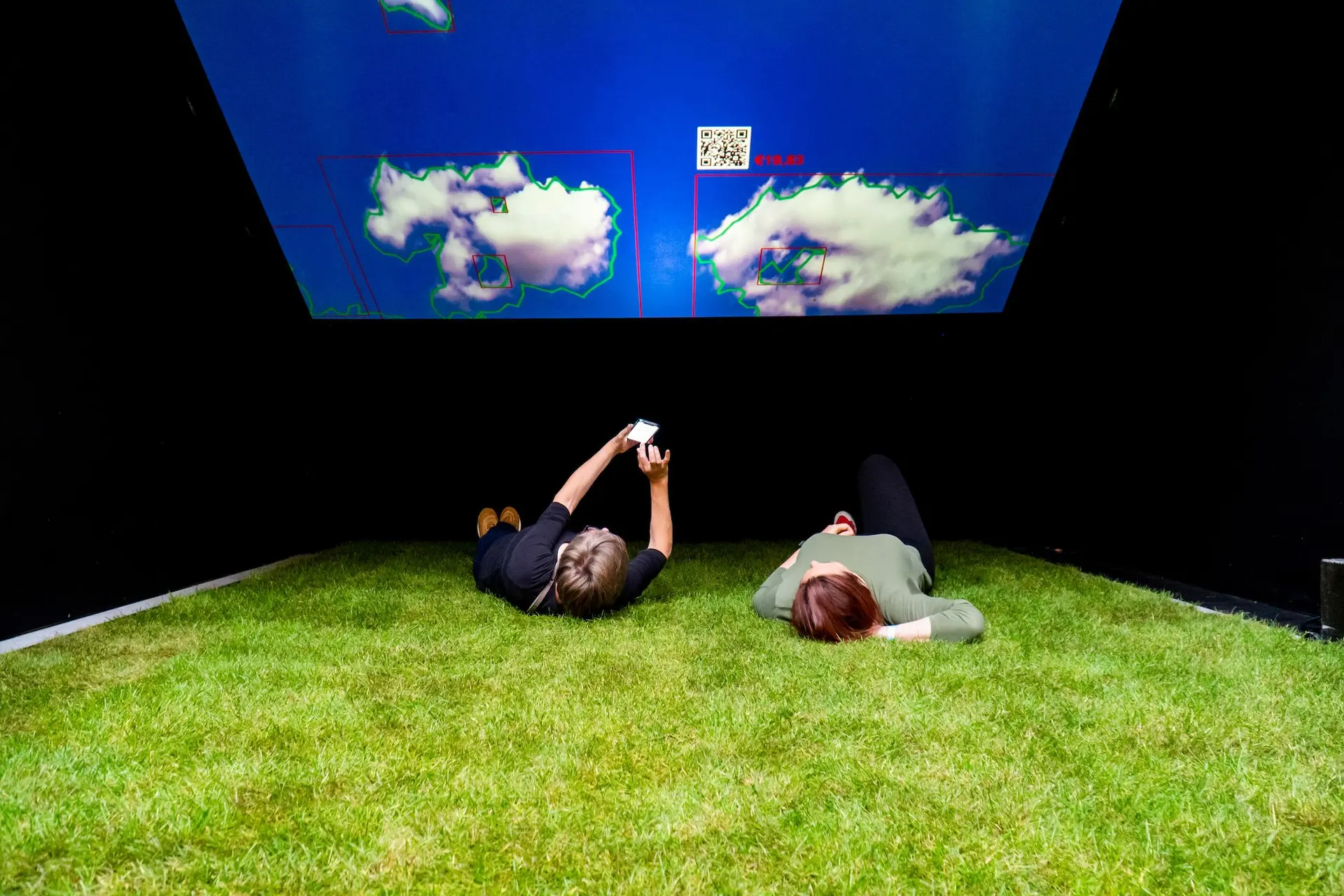
Nxt Museum. Random International. Life in a Different Resolution. Living Room (2023) Photo: Riccardo De Vecchi
Credits:
Research by Moonshot Digital Culture in collaboration with Nieuwe Instituut, for the Dutch Ministry of Education, Culture & Science (OCW).
Publication: Nieuwe Instituut, September 2025
nieuweinstituut.nl/en/pages/Distributie-Culturele-Immersieve-Producties
Research: Siuli Ko
Support: George Knegtel, Sita Struijke
Editors: Paulien Dresscher (Nederlands Film estival), Cathy Brickwood (Nieuwe Instituut),
Raymond Frenken (NAPA), Auke Kranenborg
Introduction
The Dutch digital culture field has a long tradition of content-rich and technically innovative productions, which is reflected in wide international interest and appreciation. Dutch productions regularly win awards at major and leading festivals such as Tribeca Festival, Venice Immersive and SXSW. Dutch producers and creators are also regularly involved in international co-productions.
At the same time, professionals within the digital culture field run into persistent challenges, with the distribution and presentation of immersive projects in particular being a structural bottleneck. A major cause of this seems to be the difficulty in developing revenue models or sourcing funding. As a result, many immersive works have only limited reach after a festival premiere and barely circulate sustainably within and outside the cultural field.
To find answers to these challenges, a study consisting of two parts was launched, both coordinated by Moonshot Digital Culture and funded by the Ministry of Education, Culture and Science (OCW). The first part of this research, the report Pilot Vouchers Cultural Immersive Productions, was published in May 2024. It evaluated the Creative Industries Fund NL's pilot distribution scheme. In the process, the report provided input for the then newly established Immerse/Interact presentation grant.
This second part of the study not only focuses on the Dutch field, but also looks at international developments in the field of distribution and presentation. Additionally, by including research into distribution models from other arts and culture domains - such as film, theatre, games and visual arts - this report aims to provide a new perspective on possible strategies to extend the lifespan of immersive projects. Using this interdisciplinary approach, we explore innovative strategies for distribution and make recommendations for practical and applicable approaches.
The report aims to contribute to solving the persistent bottlenecks surrounding the distribution of immersive projects and thereby support the sector. To this end, we provide tools at all levels of the chain: research, concept development, development, production and distribution. The report aims to contribute to the sustainability of immersive productions - both in terms of reach and retention.
Research Question
The research question that forms the point of departure for the study is: How can the distribution of immersive experiences (IX) become more sustainable in terms of wider distribution and better preservation?
In the report, we answer this question by zooming in on the following sub-questions:
What strategies can creators and producers deploy across the chain to remove obstacles in the distribution of immersive projects?
What practices and structures from other cultural domains (such as film, theatre, games and visual arts) can be used as inspiration for distribution of immersive experiences?
What physical or digital infrastructures - such as platforms, networks or hubs - can play a role in making distribution sustainable?
Method
For the report, interviews (see Appendix 1) were conducted with 19 leading professionals involved in IX from home and abroad. In addition, desk research was used to explore the further cultural fields (see Appendix 2). The desk research examined reports of expert meetings at various festivals as well as reports and publications of organisations and research institutes from the Netherlands and surrounding countries (mainly France, Great Britain, Belgium). During the research, the desk research was expanded to sources that provided more insight into issues that emerged during the interviews, such as existing distribution models and strategies from other sectors.
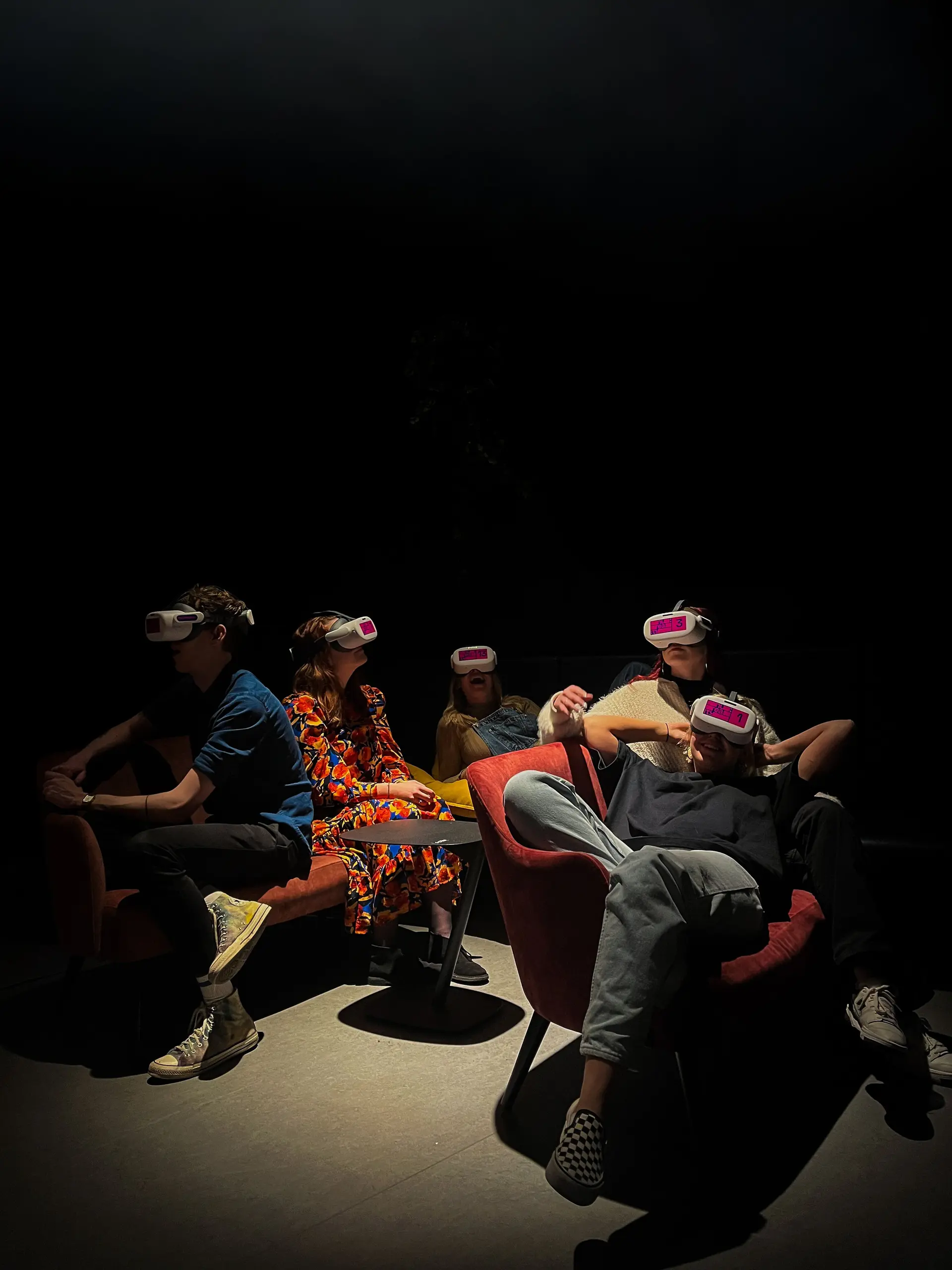
Babette Wijntjes - Filmhuis Den Haag
Definition immersive experiences
This research focuses on the immersive experiences (IX) sector: cultural media productions such as virtual reality (VR), mixed reality (MR), augmented reality (AR), 360° film and interactive installations. In practice, the term XR is often used as an umbrella term for VR, MR and AR technologies and experiences; we use that term in this report as well.
IX-projects by definition move at the intersection of different cultural domains such as film, visual arts, games, performing arts and technological innovation. As such, they transcend traditional sectoral boundaries and thus also reflect a broader societal development: technology has become deeply intertwined with a society that is becoming increasingly digitally organised. The Moonshot Coalition describes digital culture as "a field composed of many multidisciplinary practices that overlap with other sectors. This is its strength, but also its Achilles heel." This report analyses this strength and explores the bottlenecks in the whole process of distribution and presentation.
Definition distribution
Distribution of IX is about the process of making works accessible, as well as circulating and presenting them to the public. This happens through both physical and digital channels, aiming for visibility, impact and repeatability. In the context of this research, we see distribution as an important part of the chain as well as a systematic strategy for sustainable impact, reach and viability of a project. We look at aspects such as audience development, versions and formats, screening locations, scalability, and both economic and creative strategies.

❋
LAWKI Installation, ARK. Noorderlicht. Photo: Peter TijhuisAnalysis current situation
1.1 Points of Departure
The first part of the research report focused on evaluating the Pilot voucher scheme for cultural immersive productions and made recommendations for the future design of the structural support scheme. The applications, awards and rejections within the pilot were analysed.
The main findings of this report were that:
there is a limited infrastructure for screening IX productions;
the industry faces obstacles in financing both production and distribution of IX;
there is a lack of standardisation at the technical and organizational levels;
in the field of IX distribution, there is a lack of knowledge and expertise among makers, producers and institutions;
there is a lack of knowledge among policy makers and presentation institutions about the conditions and infrastructure needed to present and deploy immersive productions sustainably;
there are organisational and cultural barriers at presentation institutions, for example because staff have little expertise in technology or hosting IX;
the IX field is highly fragmented, which hinders collaboration and makes sharing knowledge and resources difficult.
It is clear that IX distribution in the Netherlands faces structural challenges. There is a lack of specialised distributors, a lack of best practices, and no standard revenue models for creators, producers and cultural institutions.
A distinction can be made here between online and physical distribution. Online distribution of immersive cultural productions is struggling because it has to compete with the large commercial productions on streaming platforms, while its own infrastructure is virtually non-existent. However, physical distribution is also running into problems.
Caspar Sonnen, head of IDFA Doclab, explains:
"It's a different business. Getting a VR game into the Metastore or putting a 2D game into the Playstation Store is a more classic distribution story, similar to a film on Netflix. This also takes into account that concepts such as 'premiere', 'distribution budget' or 'user numbers as a measure of success' differ by pipeline, by platform." In short: a different field entirely, which also requires a different approach.”
Such issues around distribution are also named in the national analysis of the XR sector, as found in the Baseline Report: The Dutch XR Ecosystem of 2024. That report also highlights a number of other relevant points:
Technological limitations: the technology does not yet work "perfectly" and this hinders wide adoption;
Financial barriers: it is expensive and there is no revenue model, let alone a return on investment;
Privacy and data security: there is a lack of clear guidelines and standards on what to do with sensitive personal and biometric data, which slows adoption;
Dependence on international companies: this leads to continuity risks, for example, through price increases, support and limited availability.
These observations show that the problems faced are not limited to the digital culture sector, but are also experienced in the broader XR industry. The findings from the first part of the study are the starting point for this second part, which constitutes a broader and more strategic approach to distribution.
1.2 Knowledge and expertise
Lack of experience
One of the conclusions from the first part of the study was that the IX sector often lacks the right knowledge or expertise in the right places or at the right times. This was confirmed during the interviews for this second phase of the study by Nxt Museum curator Bogomir Doringer, among others:
"Nxt Museum has never shown VR, even though we are interested in it. This is because it requires a lot of extra people to manage the VR sets and guide visitors. In addition, we haven't yet found a model that works within the exhibition space in conjunction with ticket sales. We just couldn't figure out how to get that working."
This is perceived as a problem throughout the industry. Distribution of XR is usually not a standard part of the programme and is often filled in ad hoc by institutions, makers/producers or festivals without a structural and professional network comparable to other sectors. There is also a lack of support for essential elements such as keeping work up-to-date and archived, or hiring specialised staff for marketing and distribution.
In addition, funding bodies are also not always equipped to deal with the specifics of the distribution side of immersive productions. For example, unlike film, IX usually does not involve a clear premiere, after which the work will tour in the same form. There are frequently several iterations and test phases, which also involve audiences. The current subsidy system is not set up for this phased development, which in turn often has to become part of a distribution plan.
Realising and maintaining IX productions is technically complex. There are only a handful of specialized companies in the Netherlands that focus on the technical implementation of IX presentations, such as Popkraft and WeMakeVR. Artist Gabey Tjon-A-Tham puts it this way:
"For me, the knowledge gap is mainly on the technical production front. Most technical production companies that provide exhibitions specialise in standard AV equipment, while what I do is extremely custom-made. They cannot provide advice or help with output."
LI-MA, a platform for digital and media art that handles the distribution of a wide range of media productions, defines distribution as an intermediary and supportive practice aimed at increasing the visibility, accessibility and sustainability of works. This definition links distribution to the assurance of sustained access and preservation of the work's cultural context.
Gaby Wijers, LI-MA's director, notes that museums already have a myriad of existing tasks and responsibilities, and that presenting immersive works requires specific external expertise.
In the aforementioned Baseline Report, Omar Niamut, scientific director at TNO, talks about the need to integrate XR projects into the existing infrastructure of the host institutions in the implementation phase. "If the technology is not embraced by IT, it often remains a one-time experiment." This approach could make the distribution of IX productions much more sustainable.
Hosts
A good audience experience generally requires well-trained hosts. They make sure the on- and off-boarding goes smoothly for the audience and can catch initial technical hick-ups.
Amy Rose, who formerly ran Anagram, a British creative studio for interactive and immersive experience design, says the importance of hosts is far from universally recognised:
"[At Anagram] sometimes we just said, 'You know what? We'll hire those people. Don't worry, we'll take care of it.' We knew how important it was, because the success of the work really depended on it. Locations don't always fully realise that, and there's often an expectation that the work should be able to stand on its own. But I don't think that's possible. And it's not just about the preparation and onboarding beforehand, but also the reception afterwards: the form is so unusual for users. We don't always know in advance what it will trigger in people. Some people cry, some get upset, others want to talk for an hour - and that doesn't happen in the same way with other art forms. These spaces are full of uncertainty, and you need human presence to respond to that uncertainty, rather than thinking we can solve that with technology."
Good onboarding and offboarding are crucial to making IX experiences come into their own. In her current position as head of Immersive at Watershed (Bristol), Rose has anticipated this situation. The organisation works with a regular group of specifically trained people:
"(At Watershed) the exhibitions are staffed by the same people. They can guide conversations that are open and inviting. In addition, it is important that they are technically savvy - for example, in turning equipment on and off and troubleshooting." In short, hosting an IX experience is a specific role that requires a lot of care.
Knowledge and training for creators and their teams
Many interviewees indicated that makers/producers often do not get around to researching needs in the market and how knowledge of these can be translated into the (concept) development of their projects. Vevi van der Vliet (LI-MA business lead) notes that a distributor can play a role here:
"You can have the conversation beforehand: 'If you have a room like this, it won't fit,' or: 'Then we can make these adjustments.' [There's] a lot of knowledge that you could share with creators beforehand, at least to get them thinking. Because in terms of content, it really makes a difference whether your work is in a (large) room, with space around it, or whether it is hanging right in front of you. I find it remarkable that this knowledge is still so little shared, while it is so important."
Simon Frijters, enterprise specialist at Unbound XR (a store for VR, AR and XR Hardware), says in an interview in the Baseline report that XR projects often lack the end-user's perspective, and therefore fail to work with their intended audience. According to Frijters, there is a discrepancy between what creators intend, and how the final experience comes across to the audience. This audience experience should be leading in the development of productions.
The interviews also reveal another knowledge gap: it is often difficult for creators to find the right balance between good storytelling and optimal use of technologies. As Tupac Martir, creator and founder of Satore Studio, put it:
"There is a gap in terms of technology, knowledge and optimisation. I think that's largely because a lot of people are not trained to really understand how you structure a story, how you convey specific elements, and how you make sure the experience works."
Amy Rose also recognizes this and sees a problem especially with large projects:
"I've seen very few projects where scale and narrative are balanced. Most large-scale projects fail to tell a good story, so they feel superficial or spectacle takes precedence over meaning."
Artistic versus technical aspects
In the Baseline Report, Rufus Baas of OASIS and XR Lab emphasises that it is important to better understand the user perspective precisely because the user is often part of the experience. This requires a totally different approach to storytelling than in more 'traditional' productions, and a deeper understanding of technologies.
A good example is the School for Poetic Computation in New York, founded by artist and creative technologist Zach Lieberman, an interdisciplinary art and technology institution that combines education in code, electronics and poetry to explore digital expression and creativity.
A European example is the CSC Immersive Arts School in Venice. Founder and artistic director Sara Tirelli says:
"There is still a huge gap - just like with computer art or new media - between the artist and the developer who actually builds the work. Often that developer ends up saying, 'I've done everything.' That's why I think every artist should understand at least a little bit of the technical language, so that a real conversation is possible. It's not about classical technical training, it's about learning a creative approach to technology. It's not about chasing the latest technology or virtual trends, but learning to 'hack' the tools at your disposal - and how to use them to express something artistic."
The CSC Immersive Arts School maintains in its curriculum that all crew members must gain hands-on experience on how a game engine works:
"Education must be experimental, co-creative and exchange-based. Interdisciplinarity is essential. In my experience, it's really about sitting next to the creator, being part of the process (...) When it comes to education, hands-on work is always the most effective."
Tirelli also points out the importance of training programmes such as the European Creator Lab, which covers all phases of a project's development. This creates space to experiment, test new ways of working and bend technology to one's own artistic will.
Information desk
Another bottleneck that recurred in both the first part and the current study is the fragmentation of the field, making knowledge transfer difficult. Several interviewees mentioned the lack of a central information point, such as a place to find information about IX locations or presentation opportunities. For Digital Culture, the Moonshot coalition could play a role in this, with Nieuwe Instituut in a coordinating role.
Lack of marketing and distribution specialists in this field
Several interviews in the first part of the study also indicated that the IX field lacks well-trained, specialist marketers and distributors. Tupac Martir says it pays for productions to join an agency:
"The right place to be is at an agency, where you are represented by people working in many different sectors, which allows cross-pollination. This hasn't really happened very much so far."
In the absence of these kinds of agencies and distributors in the Dutch field, it is currently mainly up to the makers, and increasingly producers, to take on the role of distributor. This picture is confirmed by Babette Wijntjes, producer at Cassette Stories and initiator of Nu:Reality:
"There are no distributors in the IX sector like there are in the film industry; people who are experienced, and do it on a daily basis. Let alone best practices. It's pioneering."
Corine Meijers, producer of Studio Biarritz, wonders if that distribution role should really lie with the producer:
"You just pick it up. And it actually deserves more attention. You want to have dedicated people working on this, or companies that specialise in it. But the tricky thing, of course, is that it's not yet making a lot of money. So who's going to jump into that gap? I do think we (as a sector), with the expertise and network we have, should join forces."
1.3 Presentation Spaces
Location based presentations and at home
Where does immersive work currently end up? To understand the research field properly, it is important to identify the types of 'presentation spaces' that currently exist. These can be divided into physical places away from home, and at home in one's own environment. From the interviews and desk research, it appears that IX presentation outdoors can be divided into four categories:
Festivals
Film and digital culture festivals, such as IFFR in Rotterdam, NFF in Utrecht, IDFA in Amsterdam, but also STRP in Eindhoven and Noorderlicht Festival in Groningen, regularly show IX and are currently by far the most important places where physical IX can be experienced. IDFA DocLab has an R&D programme that, according to Caspar Sonnen, is linked to the presentation of work:
"Our R&D programme, is one of our main pillars and offers makers a space to physically present their work. We work with several production partners such as Popkraft, WeMakeVR and Diversion in France." In his view, as a festival, it is important to continuously do research as well as show work. It is there where the strength of a festival lies.
Marieke Nooren (immersive art distribution expert) sees a lot of potential in theatre festivals:
"We once presented at Holland Festival, but theatre in the Netherlands and abroad is having a hard time, so it is difficult to bring in new forms (of storytelling). At theatre festivals, I see opportunities, especially if a project is very much in line with the theme, or if it has a strong performative character."
Museums and permanent art spaces
Museums are often viewed as traditionally organised institutions, in which technological innovation is perceived as complex, expensive, or even intimidating. At a sector-wide consultation on XR distribution organised by Venice Immersive in 2023, the importance of actively involving programmers and decision-makers at museums and other cultural institutions in the creation of IX was emphasised.
Another important structural difference between museums and the immersive technology sector is the long-term planning rhythm of museums: exhibitions are often curated three to four years ahead, while the distribution planning of IX productions is usually shorter. One possible solution suggested during the Venice sector-wide consultation was to utilise little-used spaces of museums for temporary VR productions. A concrete example is the Barbican Centre in London, where in the summer of 2025 the large-scale immersive programme Feel the Sound took place.
There are also a number of permanent (art) spaces in the Netherlands offering IX in their programme, such as MU Hybrid Art House, Tetem, Nxt Museum, and EYE Museum. In several cities, old industrial real estate is used as locations to rent for IX, such as DOOR in Amsterdam, Brutus and Katoenhuis in Rotterdam and Koelhuis and Microstad in Eindhoven.
In surrounding countries there are more permanent presentation venues, such as ZKM, Hartware Medien Kunstverein, Julia Stoschek Foundation and The Dark Rooms in Germany. In Austria, Ars Electronica and Belvedere. In England Watershed, Barbican Centre, 180 Studios, Broadway and FACT.
According to Merel van Helsdingen, director of Nxt Museum:
"The traditional white cube gallery, or one of those monumental buildings with large windows, wooden floors, with lots of light or glass, you still often see those. One of the biggest challenges we face is that you need a very different kind of space for this kind of art. That's also the reason we set up Nxt."
Public spaces
Public spaces such as libraries, malls, train stations or other outdoor public locations increasingly offer opportunities for presenting immersive experiences. A leading example of a public venue at the forefront of immersive content programming is Forum Groningen. The building combines library functions, cinemas, exhibition spaces, a Fablab and public meeting spaces under one roof. Rozet in Arnhem is another good example.
Babette Wijntjes initiated the XR programme Nu:Reality in 2022, which offers a biannual XR programme in nearly ten cinemas across the Netherlands. She explains:
"There is no lack of interest from the public, we have tested that. There is also no lack of cultural venues that could do something with XR. But it still proves difficult for individual locations to actually commit. In the end, it always comes down to cost."
Unique locations
Immersive works can also be shown in temporary, specially designed locations for periods of several weeks to months. Within the XR sector, such screenings are known as Location-Based Events (LBEs). One of the best-known LBEs in the Netherlands is the screening of Alejandro González Iñárritu's Carne y Arena, organised in 2018 by EYE in an industrial space in Amsterdam-Noord.
The 2022 report by Digital Catapult and Audience of the Future analyses the rise of LBEs in the run-up to the corona pandemic. In the United States, LBEs remain an important distribution model, often in partnership with museums. The British XR studio Vision3 exhibits its work in US museums for a period of at least 3 months. Jenni Tuovinen, head of operations at IDFA DocLab, points to the rise of domes and planetariums, which operate within the Full Dome Creative Network.
At home
Viewing immersive content at home requires people to have access to their own VR headsets. Caspar Sonnen also wonders if this approach is desirable:
"The impact of minerals and everything it takes to make VR headsets is at least as big as the challenge we have around phones. The impact on the Earth if everyone, or a substantial part of the West, owned VR headsets, would be immense. It's much more sustainable to create places where VR is shown, where people go, rather than everyone having a headset themselves."
Digital storefronts play a central role in online distribution. Steam is the largest worldwide, but is primarily focused on games and offers limited space for XR titles. As a consequence, international film festivals are working on an alternative: The Festival Collection, a curated online platform featuring previously screened festival selections.
SideQuest VR offers an alternative accessible platform for experimental content. Viveport Infinity also publishes artistic titles alongside games, selecting for a title's longer shelf life.
According to creator Abner Preis:
"I strongly believe in online distribution, but not necessarily only via computer. For example, the MET in New York livestreams their opera performances to cinemas, and they sell out. I would call that an online experience. [...] I think we're really shortchanging the possibilities of something so financially accessible."
1.4 Shelf Life and Archiving
"All these pieces that are being made, all the money that's being used to fund all these things, where are they being seen? Who else gets to see them?" Tupac Martir (creator, founder Satore Studio)
As outlined in sections 1.1 to 1.3, the current distribution infrastructure for IX is fragmented and unsustainable. Festivals play an increasingly important role as a launch pad, but rarely provide a long-term pathway for further presentation and distribution. After the premiere, there is a lack of committed institutions that continue to provide technical and substantive support for the work. And if we want to preserve works for the future, we must also engage in preservation.
Maker Nienke Huitenga ran into this issue while looking for productions she had seen at IDFA DocLab over the past few years:
"There are fantastic works that have influenced me, but is any of that still preserved? Is there a small archive of the exhibitions? No, there wasn't. I think that as a sector, we have difficulties on this score. Not only is it problematic that the work is no longer available, but we don't pay attention to the knowledge that is lost in the process."
According to Vevi van Vliet:
"You can only make something visible if you have also thought about how you will preserve it and manage it in the future. That means documenting well how you exhibit it somewhere. We have elaborate processes for that."
Tupac Martir indicates that keeping a production presentable or preserved is not always easy:
"If I wanted to present Cosmos Within Us from 2019 now, I would probably need another four or five months to bring the work to the level and scale it for today's requirements. Some works can certainly be preserved in the state they are already in. But there are also works where the creator's original idea is not fully realised, simply because of the limitations we faced at the time."
In the Netherlands, LI-MA is currently the only organisation dedicated to archiving media art. Gaby Wijers explains:
"Keeping all those works in perpetuity is quite complicated and complex; it requires a lot. So making a selection is better. Suppose fifty immersive works are made in a year, which frankly I think would be great, you can't preserve them all. Certainly not if fifty more are added every year. So then you make a selection from that."
Artist Boris Acket emphasises:
"It's not so interesting that I have stuff in my warehouse, the issue is what happens to it when that stuff is no longer there. Where are the drawings then? Where are the files? And who will make sure that is preserved?"
As a strategy to support archiving and preservation, creators and producers may see museums and other institutions as potential partners. In the Netherlands, the Stedelijk Museum in Amsterdam and Museum Arnhem have occasionally purchased IX works. An institution like Nxt Museum in Amsterdam expresses the ambition to play a structural role in this as well.
1.5 Funding
Financing IX projects remains a challenge. The main scheme in the Netherlands is the Immerse/Interact scheme at the Creative Industries Fund NL and Netherlands Filmfonds. Under certain conditions, a project can also receive funding from the Digital Culture scheme of the Creative Industries Fund NL or Cultuurloket DigitALL, as well as the Mondriaan Fund and private funding bodies such as Cultuurfonds and Fonds 21.
Corine Meijers, producer at Studio Biarritz, notes that it is nice that a distribution voucher scheme has now been created, but it is available only for those projects funded within the Immerse/Interact scheme.
It is difficult to finance projects in their entirety from cultural subsidies. Countries in which partnerships with telecommunication companies are set up for distribution can be an inspiration, as happens with Deutsche Telekom or Orange France. At the same time, many media companies in Europe have just stopped their immersive line, such as Sky, BFI, BBC, Arte and The Guardian.
Innovation programmes
There are several innovation programmes in the Netherlands, such as under NWO or the National Growth Fund, which may be relevant in some cases. These include the Regional Development Companies (ROMs), which offer programs for technical innovation. The MIT scheme specifically targets SMEs. There is also the SBIR scheme, which provides grants for the development of innovative products.
For applied research between SMEs and knowledge institutions, there is the RAAK programme (Regional Action and Attention to Knowledge Circulation). Recently, there is also CIIIC, part of the National Growth Fund, from which immersive experiences (IX) are funded, among other things.
An example of a cultural organisation exploring collaborations involving science is Monobanda, which regularly participates in larger research projects. For media artist Ivan Henriques, collaborations with scientific trajectories are also at the core of his professional practice.
The connection to purely artistic projects of these large programmes is often limited. Such programmes typically require market orientation, scalability and co-financing. For the smaller, independent projects, this is more difficult to achieve. Thus, in most cases, such programmes are a complementary set of instruments, but not a structural solution for financing immersive art.
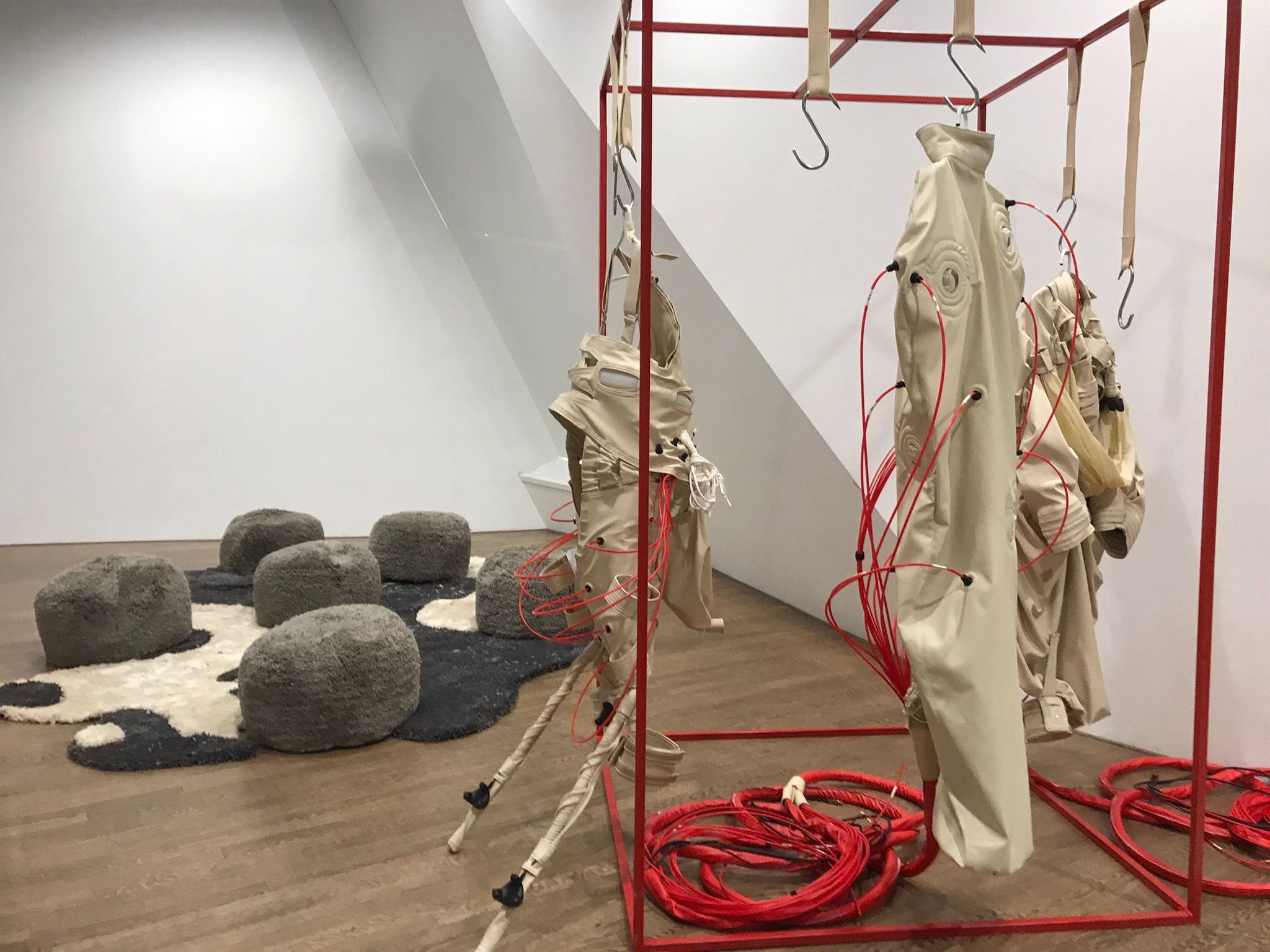
❋
2. The Lifecycle Concept from a Distribution Perspective
"Creators should see their work as a fluid entity: intellectual property that can change form and adapt to different distribution options."
The Creative immersive content lifecycle: from distribution to restoration (Digital Catapult, 2022)
Symbiosis. Polymorf, 2021. Foto: Marieke Nooren
2.1 Lifecycle
The realisation and distribution of XR productions are approached in an interesting way in Digital Catapult's 2022 report, "The Creative immersive content lifecycle: from distribution to restoration." The report proposes a holistic long-term vision of the entire chain of immersive production, within which distribution is integrated. According to the report, the ideal chain can be divided into five successive stages:
1. Pre-production
In this phase, the concept is developed and the necessary funding is raised. Although the focus is usually on creative development, this is precisely the time to also think strategically about the intended audience, forms of public outreach, the distribution possibilities and the technical scalability of the work. This is also increasingly required by funding bodies in the Netherlands.
2. Production
During the production phase, the work is realised. For successful distribution, audience development and the design of a content strategy that makes the work sustainable and reusable in the long term should be started in this phase. It is also valuable to think about possible distribution and licensing models as early as this stage.
3. Display
The screening phase starts with the premiere and covers an important part of the life cycle. Maximising screening opportunities is central here. Within this screening phase, four sub-phases can be distinguished:
Festival premiere and tour;
Longer-term screenings at LBE (Location-Based Entertainment) venues;
Touring, both nationally and internationally;
Syndication (coordinated distribution) through a distributor or network of presentation partners.
4. Further development
Further development is essential for projects that eventually want to also focus on digital platforms and home use. This not only increases the longevity of the work, but can also lead to new audiences or increased exposure when relaunching.
5. Archiving and presentation
The final stage of the chain focuses on the lasting preservation of the work. Documentation of the creative process, artistic intent, technical specifications and contextual information form the basis for future reproduction or research.
Case study: In Pursuit of Repetitive Beats
Darren Emerson's In Pursuit of Repetitive Beats (2022) is a large-scale, interactive VR installation that immerses the audience in the atmosphere of late 1980s British rave culture. The experience combines haptic technology, sound, wind, projection and light, and is designed as a total experience.
Emerson and his team work with a stepped tiered distribution model: from a full version in which the team as "event producer" provides and executes everything, to lighter versions in which it provides only the software and guidelines that allow a local partner to display the work independently. This allows the work to be shown in multiple places at once.
After touring some 20 countries, an 18-month UK tour began. The team has found solutions to the problems they encounter, such as the institutions' lack of technical knowledge or their limited financial clout. Because of the Arts Council's pre-funding, the team has been able to take care of the costs and execution for the first ten days of the show at each venue. This has reduced the risk for the venue, after which it can continue programming independently.
According to Emerson, it is important for immersive installations to be embedded in an institution's regular programme. In his view, the public's interest is primarily piqued by the subject matter and story rather than the VR itself. In Birmingham, 60% of visitors had never tried VR before. Just as many had never been to the museum itself.
2.2 Documentation
From the Digital Catapult report as well as the experience of In Pursuit of Repetitive Beats, we learn that it is crucial to think about preservation and reproduction of an experience from the concept phase. Many immersive works are by definition temporary, site-specific and technologically complex. This is precisely why it is essential to carefully document the entire creation process - including the artistic intentions of the creator.
Good documentation not only supports the internal process - such as making creative choices or looking back on them - but is also vital for external purposes, such as pitching the work, reporting to stakeholders and archiving for future reuse. Part of the documentation can be a concept bible: a document in which the visual, content and production principles of the work are recorded.
This systematic recording of the essential characteristics of a work were named by Professor Pip Laurenson, who specialises in the conservation of contemporary art, in 2005 in the Tate Papers. Good documentation includes:
Artist's instructions;
Approved installations for reference;
The context in which the work was created;
Description of to what extent technical or content choices are representative of the creator's style or method of working at the time.
Types of documentation
Media and preservation researcher Annet Dekker, in Enjoying the gap: comparing contemporary documentation strategies (2013), distinguishes three overlapping forms of documentation, each fulfilling a different function within the life cycle of a work:
Documentation as process: the use of documentation to aid creative and production decision-making during development.
Documentation as presentation: capturing the work in text and image, for example, for promotion, education or archiving.
Documentation for the purpose of future reconstruction: information recorded in such a way that the work can later be presented or reproduced again, even if the original technology has become obsolete.
Toolkits and roadmaps
Within media arts, a number of toolkits have been developed in the past for documenting work and work processes. Examples include the Variable Media Questionnaire, The Media Art Notation System (now discontinued) and V2_'s Capturing Unstable Media Conceptual Model. Appendix 3 of this report has formulated an initial format for creators based on the way technical documentation is done within software development.
Installation documentation and service design
Installation documentation should not only capture the original technical design as completely as possible, but also acts as a living document. It is a constantly updated log that grows with the development of a project.
Maker Nienke Huitenga and tech dramaturg Marijke Hessels began research in the summer of 2025 to develop a cheat sheet for makers:
"It's very complicated as a maker to put your own process into words, because a lot of these things happen from maker intuition. You then have to find words for that."
A successful Dutch documentation methodology is that of Instrument Inventors Initiative (iii). They have been publishing the Blueprint Series since 2023, a series of publications offering detailed documentation of performative sound art works and interactive installations. Each publication acts as a manual through which a specific work can be reconstructed and understood.
This broad knowledge sharing within the sector is at least as important as documenting itself. Representative bodies on the maker side, such as VPT, NAPA or Kunsten'92, can also play a role here.
Gaby Wijers also advocates not only archiving the work itself, but also more research into the documentation of audience participation:
"How is the work experienced, what works and what doesn't in terms of interaction? There are also big differences there between venues."
2.3 Audience Involvement & User Testing
Although it sounds logical to involve the intended audience during the development or production phase, makers and producers still do this too infrequently. In the game industry, such user-testing is a standard part of concept development, as Yannis Bolman, CEO of Little Chicken explains:
"If you're going to make something, first you're going to see what type of game you want to make and whether there are 'communities' for whom this is interesting. You then start asking what they find interesting."
Marieke Nooren also sees the importance of testing, preferably as early as possible:
"I think it helps if a creator not only looks at what story they want to tell, but also at what they really want to convey and what kind of impact they want to have."
It is important to view user testing not as a one-time moment, but as an ongoing process within the lifecycle of the work. Structurally testing with diverse audiences - from the initial prototypes to after the festival round - not only increases the quality and impact of the work, but also the likelihood of long-term sustainable dissemination and relevance.
2.4 Prototyping and Versioning
Many immersive projects develop in stages, with research processes in which each version leads to new insights in terms of interaction, narrative and technical feasibility. It is important to distinguish between prototyping and 'versioning'. Whereas prototyping is about developing a work through successive iterations, versioning involves showing multiple versions of the same work side by side.
Gaby Wijers explains how prototyping works:
"Many media artists are constantly coming up with new versions, often because the (work) is not only a concept, but also a work-in-progress, or rather, a research process."
XR artist Daniel Ernst sees the importance of versioning. For his work The Great Orator, he has developed three versions: a festival version with a linear narrative and framed duration; a game version that offers players an infinite simulated open world; and a museum version that emphasises the physical exhibition experience. Other creators are also experimenting with these kinds of hybrid forms.
Tupac Martir says he is open to making a smaller version of 2019's Cosmos within Us, if that would allow the work to tour:
"I think there is potential in a different way of presenting it. If we want Cosmos Within Us to tour, maybe we could make a smaller version - one with just one musician, a conductor and a voice-over. It's about figuring out how far we can take it back without losing the essence."
Both prototyping and versioning are crucial within sustainable lifecycle thinking of a production. Prototyping is an instrument for quality improvement during realisation. Versioning enables wide dissemination in different contexts and responds to diverse public expectations. Digital Catapult's research asks whether digital components such as 3D models, animations or sound assets can be reused in other contexts or formats.
2.5 Marketing Strategy
Ideally, the marketing and communication strategy is incorporated from the very start of the concept phase. Questions such as who your audience is, how to reach that audience and through which platforms and networks, should be asked early in the lifecycle. Tupac Martir points out that it is difficult to keep the earmarked marketing budget entirely reserved for this purpose:
"You'd rather put that budget into the work itself than into a huge marketing campaign."
Outreach
Actively seeking out relevant partners, networks and audiences - also called outreach - is indispensable, but time-consuming. Babette Wijntjes of Nu:Reality sees a lack of people who focus specifically on marketing and publicity:
"The disadvantage is that at the moment there are very few people in the cultural sector who deal specifically with this subject. So I also very often say to marketers, social media specialists or publicity people: specialise in it. Research it. Become an expert. There's a real need for it."
In line with the case study In Pursuit of Repetitive Beats, Tupac Martir, Marieke Nooren and Amy Rose also think that in a good communication strategy you should not focus too much on technology. Instead, you need to clearly communicate what the work is about, what the aesthetic or cultural value is and what the audience can expect. Martir calls this addressing the performative power of a work.
2.6 The Importance of Data
In order to properly substantiate the value of a work and develop strong business models, reliable audience data and revenue figures are important. These are generally lacking in this sector. There are no sector-wide insights or projection tools that help creators and producers predict their audience reach or revenue models. A study on the economic and social impact of IX, Understanding of the market and needs of XR companies in France, was conducted in France in 2023. A similar study in the Netherlands would be very valuable. There may be a role here for organisations such as CIIIC, the Boekman Foundation or Nieuwe Instituut. Section 1.3 described the idea of the Festival Collection. Such a platform for Dutch immersive content could be set up by See NL.
2.7 After the Festival Tour?
Lifespan
Thet prove problematic in practice. Amy Rose recounts her time at Anagram:
"As a company, we were never really able to distribute projects successfully if they had been on the festival circuit before that. It was incredibly difficult to follow up a project with an installation in a meaningful way. Very occasionally something was chosen by a gallery, but that was always based on relationships and allies, not through some existing distribution network. But that's not a sustainable business strategy in the long run."
Caspar Sonnen also agrees:
"The moment a work is at IDFA, the ambition is to have it go around the world. But the chances are very real that such a work will never be shown anywhere else after that, simply because it is so expensive and complex."
This festival-dead-end proves difficult to break: the moment when a work has nowhere to go after a first premiere or limited festival tour is an impasse perpetuated in part by the stubborn premiere requirement of many A-list festivals.
This festival-dead-end proves difficult to break: the moment when a work has nowhere to go after a first premiere or limited festival tour is an impasse perpetuated in part by the stubborn premiere requirement of many A-list festivals.
According to artist Boris Acket, the fact that the existing presentation infrastructure does not facilitate sequels means that the pressure to move on to the next project is great:
"With me it was often the case: we just managed to realise this within a festival. But it is so expensive to repeat it, because those big works - like at DGTL - were actually only possible within the architecture of that festival."
Beyond the festivals
The aforementioned Nu:Reality, which structurally programs 360-degree VR and VR installations in film theatres, is trying to break this impasse. Babette Wijntjes:
"If you don't have structural VR programming in film theatres for a year, then the accumulated knowledge within the organisation and with the staff disappears. You also have to re-tap the audience, and so you need money for marketing again. So continuity is really crucial."
Festivals are key players in the ecosystem around immersive works. They provide visibility, legitimacy and access to a professional network. Caspar Sonnen stresses the importance of matchmaking and knowledge sharing:
"There is also a very large part of matchmaking in what we do, such as us sitting down with MIT as Moonshot. So knowledge exchange and partnerships can happen organically and directly between people."
It remains a challenge to show IX in other venues after an initial (festival) premiere. This requires not only structural investment, but also a cultural shift at festivals and institutions. The work must be able to land more widely - not only at festivals, but also at museums, galleries, libraries or even amusement parks.
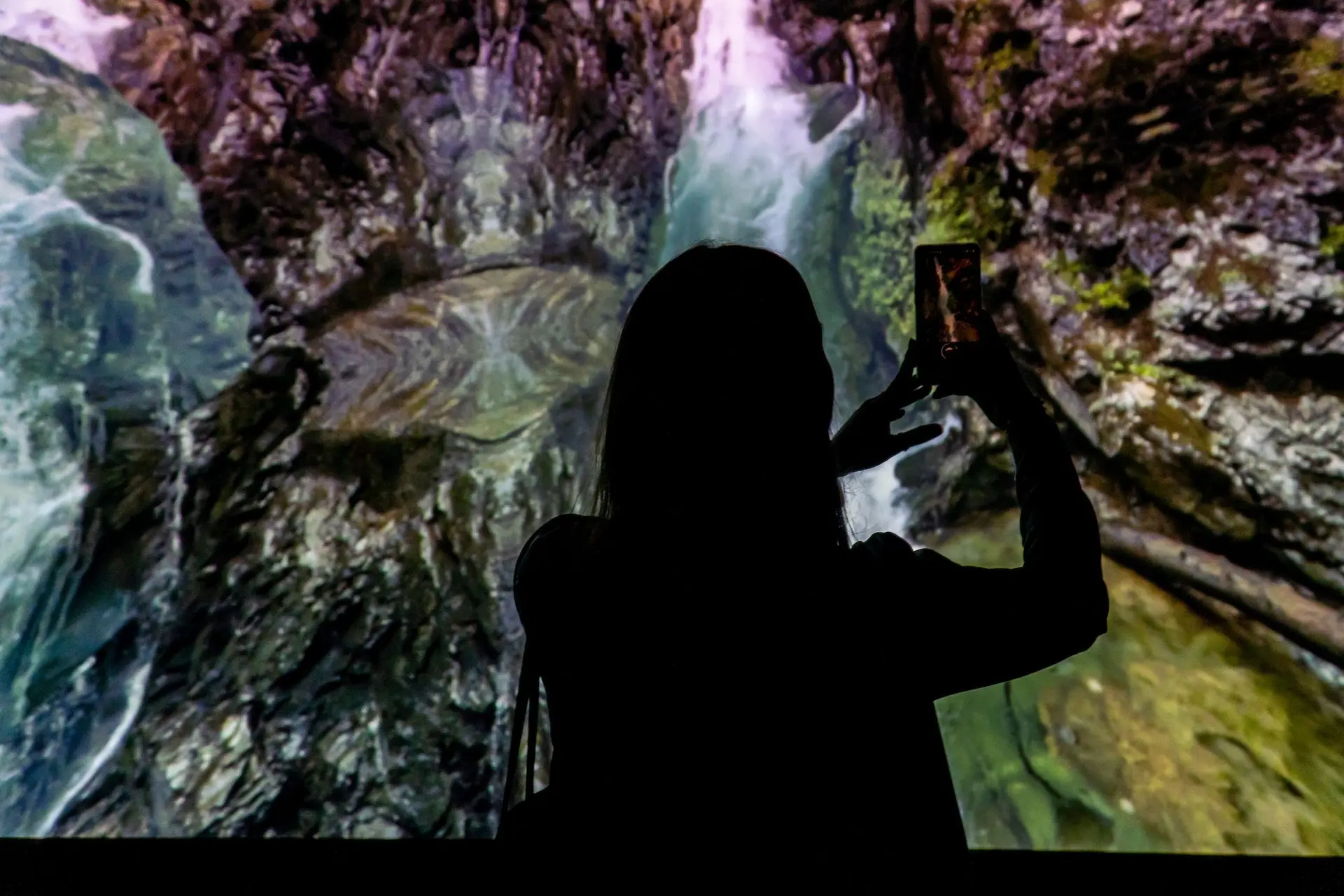
❋
3. Distribution models
Habitat. Heleen Blanken. Nederlands Film Festival Storyspace, 2020.
Photo: Joke Schut
This chapter looks at distribution models prevalent in other cultural subsectors: film, performing arts, visual arts, games and music. What lessons can creators, producers and other stakeholders draw from it? How can these insights be used to arrive at more sustainable and accessible distribution models for immersive content? One important conclusion: a distribution strategy need not be based on a single model. On the contrary, a thoughtful strategy often consists of a combination of multiple models that complement each other. The more diverse the forms of distribution used, the greater the chance that a work will reach multiple audiences and remain economically viable.
Sara Tirelli aptly puts it:
"You absolutely need to adopt a hybrid mindset to produce and distribute IX. One that understands what the moving image industry does, what theater has long done, and also draws from live performance, gaming, and the arts."
3.1 Film
"The industry tends to treat XR as if it's cinema. That means they apply the same production models, but when it comes to distribution, it's like an eternal void." Sara Tirelli
The cultural IX sector strongly orients itself to the distribution model of the film industry. In the film world, distribution is a mature and firmly embedded system, with distinct roles for distributors, sales agents, cinema operators, streaming services and international marketplaces.
Business models film distribution
A film distributor's revenue model is made up of several revenue streams. An important component remains box office revenue: distributors receive a percentage of ticket sales in cinemas, often around 30-50% of the revenue. Distributors can also take advantage of incentives such as the European support programme Creative Europe MEDIA. In the IX sector, projects that recently received contribution under the Immerse/Interact programme can apply for a distribution voucher.
Territorial approach and 'windowing'
In the film sector, it is common for sales agents to divide worldwide rights into licences by country or region. In addition, the film industry follows the so-called windowing principle - in which a film is released in phases through different channels such as festivals, cinemas, VOD platforms and television. This can provide inspiration for building a distribution roadmap within the lifecycle of immersive productions.
Marketing strategies
Another lesson from the film industry is the emphasis on audience building and contextualisation. Distributors invest in promotional materials, press relations, subtitling and educational support. For the same reason, audience outreach is even more important for IX than for film.
Standards
Following the example of the film industry, serious steps are already being taken in France to develop technical standards to facilitate the distribution of XR experiences. Launched in 2022, the partnership between FIS (French Immersive Studios) and PXN is developing joint standards on which creators, studios and producers can base their content.
Case study: lessons learned from short film
It is relevant to look not only at feature film distribution, but also at the parallels with short film. Like many immersive productions, short film lives primarily within the circuit of festivals, themed programs or special screenings - and then often disappears from view.
Martir argues that XR should look at how short film managed to organise itself between about 2005 and 2017: a period when innovative forms of distribution emerged such as online bundling, educational use, or integration into cultural events. Andrew Allen's article "Lessons From a Decade of Short Film" shows how small-scale productions managed to find an audience outside traditional channels.
In this period, specialised distributors for short film also saw the light of day - think Shorts International or Ouat Media - dedicated to digital sales, international licensing, and compilation releases. A similar infrastructure for IX - with hybrid models, curation and alternative revenue structures - could help the industry extend the life cycle of immersive projects.
3.2 Performing Arts
Buyouts vs. ticket sales
The performing arts - including theatre, dance and performance - has developed its own distribution models over time. Traditionally, companies worked with a so-called buy-out fee: a fixed fee paid by a theatre or festival for screening a performance. IX creator Tupac Martir also primarily uses the buyout model for the distribution of his work:
"Usually we just get a fee, and then we go and build everything. It's very much like a traditional theatrical model."
Marieke Nooren points out the challenges around ticket systems for XR:
"The ticket sales system seems difficult to me, especially with VR, because the number of participants per session remains small."
Active role creators
Typical of the performing arts is the active involvement of the company in the distribution process. It is usually determined at an early stage where the work will be shown, who the audience is, and how the programme will be embedded. Marieke Nooren indicates:
"The risk increasingly lies with the theatre companies themselves. It used to lie with the theatres, but now creators are expected not only to bring the work, but also to bring audiences, positioning and sometimes funding."
Fixed venues
The performing arts mostly use fixed screening locations such as theatres and other venues. The black box of a theatre - unlike many white cube exhibition spaces - almost always has a usable technical infrastructure such as rigging, projection capacity, lighting and sound systems, and technical staff. This makes theatres ideally suited for building more complex immersive installations.
3.3 Digital and Media Art
Digital art and media art have some overlap with the IX sector. Other organisations such as V2_, Fiber, Creative Coding Utrecht, iii or IMPAKT, and festivals such as Noorderlicht, STRP, Sonic Acts, Schemerlicht and Conflux combine these different disciplines.
There are not many distributors for media art worldwide. The DINAMO network, the coalition of media art distributors, has just under 30 members. Most members focus more on outreach than revenue, and usually operate on a nonprofit basis.
Documentation
An important lesson from media art: it benefits distribution if documentation and (future) conservation and archiving are taken into account at an early stage of the creative process. In this regard, Boris Acket argues that the 'architecture' for the purpose of collection formation and preservation is lacking in media art as a whole. Here, among other things, lies a role for heritage institutions; the NADD (Network Archives Design and Digital Culture) is engaged in research around this theme.
Equipment and knowledge
An important aspect of distribution of media art - as well as immersive work - concerns (the transportation of) equipment and technology. This is often expensive and vulnerable. Boris Acket tells how he tackled this:
"At one point I thought: owning the material is actually a way to kind of initiate that distribution myself. (...) Then I started thinking in modular systems - in what ways should I be able to build something? Something that can stand on a stand, be waterproof, be placed on a ground screw and also be hung - something that is very flexible. (...) Everything that I thought would be really impossible to show internationally is now just going everywhere - from Australia to Mexico to America."
Preservation of time-based art
A specific category of works of interest for preservation purposes is time-based art: art forms that unfold over time and in which movement, duration or change is essential. Major art museums such as Tate, the Victoria & Albert Museum, Guggenheim Museum, Smithsonian and MoMa are at the forefront of complex methodologies for the conservation of time-based art.
Rhizome, the new media art hub affiliated with the New Museum in New York, developed the concept of 'object boundary': a term that can help one think about what does and does not belong to the artwork when the work can be presented, collected or distributed.
Travelling Exhibitions
An interesting format from media art are travelling exhibitions, such as WRO on Tour and the Abandon Normal Devices (AND) tour. Another relevant example is the European Media Art Platform (EMAP), which grew out of the EMARE programme that began back in 1995. Within this European network of media art institutions, artists are selected for production residencies at partner institutions. The resulting new works then tour other institutions within the network.
Agencies
The agency model may also offer perspectives for IX. Agency initiatives in the past by V2_ (Rotterdam) and iMAL (Brussels), ultimately proved unsuccessful. However, the agency of iii (Instrument Inventors Initiative, The Hague) persists.
Encapsulation
Another interesting strategy from media art practice is encapsulation: the packaging of software within an independently functioning technological object. Here, instead of a stand-alone software file, the work is delivered as a pre-installed experience on a specific, ideal hardware configuration. For distribution of certain types of IX work, encapsulation offers interesting leads.
In the IX industry, this is referred to as 'suitcasing': the act of adapting a work into a package of installations that can be easily transported and set up and presented. Marieke Nooren notes:
"How do you make it a good package so it can be transported properly? Technical producers who understand how IX works and can put that down well, and who have experience with cargo, international transport, and the like, are crucial."
The Emulation as a Service model (EaaS) developed in digital art uses encapsulation as a logistical solution. It is scalable and cost-effective and is primarily used within heritage institutions. EaaS makes it possible to make obsolete software, operating systems, or digital environments accessible through modern systems.
Digital distribution: NFTs and social media
Although the NFT hype now seems to have blown over, this system offers starting points for developing new forms of licensing (see also 3.7). In addition, the use of social media is an interesting way for creators to generate attention for their work and to break the traditional economy of scarcity from art.
3.4 Games
"In the old days, at least ten, fifteen years ago, a game came out on a box. Then it slowly became available digitally. (...) In addition, it is now almost standard for a game to be expanded after release with DLCs (Downloadable Content). That way you keep gamers' interest and you can sell them additional content later as a 'deluxe version' of the game." Yannis Bolman
Online Store Fronts
Online platforms such as Steam have taken a dominant position within the landscape of game distribution. With more than 130 million active users, Steam has become the largest online distribution channel in the world. Artistic productions are only a marginal segment in this.
Within the traditional game distribution model, publishers play a central role. Games are increasingly approached as services rather than closed products. This is reflected in working with game 'versioning' and Downloadable Content (DLC). A great example is the strategy of American studio Tender Claws, which temporarily expanded their VR app The Under Presents with an in-game live theatre show The Tempest, generating both in-app sales and ticket revenue for the live performance.
Community Engagement
Adding a social or live dimension to content through forms of community engagement, as happens in gaming in the community platform Discord, are interesting practices whose potential value to the IX sector could be explored.
Cloud based gaming
The cloud-based gaming model, where games run on powerful remote servers rather than locally on the user's hardware, provides inspiration for immersive work. The best-known cloud game streaming platforms are XBox Cloud Gaming and GeForce Now. A subscription model could contribute to a more structural and scalable revenue model within the IX sector.
Independent distribution
An inspiration for an alternative to the dominant distribution channels is the platform itch.io. This platform allows creators to offer their games on their own terms. They decide the price, distribution method and content of their product pages. For XR and immersive creators, a similar platform could be an interesting route.
Data collection
In the gaming industry, the use of data analysis, benchmarking and statistics is well established. Parties such as Newzoo are leading the way when it comes to market insights, usage behaviour and sales figures. Such data can also be used to implement sustainable revenue models and demonstrate impact to funders and partners.
3.5 Music
For IX distribution, the structure of the music industry may also offer examples of how artistic productions can reach their audiences through various channels and intermediaries.
Intermediaries
In the music industry, booking agents and bookers act as essential intermediaries who connect artists with venues, festivals or clubs. Vevi van Vliet emphasises the collaboration between all those parties:
"I think it's interesting to look at the music industry. There, the work is central to the artist, but there is a whole team around it: the distributor, the label that invests because it believes in the product, and PR and marketing. The artist is leading, but the knowledge and expertise are all at the table, contributing together, and getting something out of it."
For the immersive sector, the introduction of specialised distributors or "immersive bookers" could be a game-changer. Such bookers could act as a link between creators of XR experiences and presentation venues, such as museums, theatres, festivals and pop-up venues.
Combination of distribution models
Platforms like Bandcamp illustrate how musicians can offer their work without an intermediary in various forms: from free streaming and paid downloads to premium collectibles such as vinyl records and special merchandise. This model combines accessibility with a market for exclusivity.
The other side of the coin is the danger of "spotification" - a term that refers to the dilemma of digital art forms becoming dependent on platforms such as Spotify, with revenue distribution highly unfavourable to creators.
Multiple interpretations
A third interesting aspect from the music sector is the way in which musical pieces are considered dynamic and multiply interpretable works. Compositions are played by different artists on different stages, in different versions and performances, yet remain the same work. For immersive works, this means making room for small-scale, experimental presentations alongside large-scale productions.
Communities
Finally, the development of communities and fan bases within the music industry deserves attention. Music fans organise themselves in fan clubs, online forums and at live events; this is an important driver of sustainability and growth. For IX, building such communities around creators and projects can provide a more stable outlet and more organic distribution.
3.6 Immersive Distribution Models
In this section, we look at initiatives and distribution models specifically tailored to exhibiting IX work. A common denominator for many of the initiatives mentioned below is the emphasis on joining forces and titles, and networking and collaboration.
Cooperation to strengthen infrastructure
Initiatives have emerged in various places in Europe that contribute to strengthening a shared distribution infrastructure. The Galaxy Network, an initiative of France's Diversion/Cinema, focused on simultaneous presentation of VR top selections in multiple countries, through a network of cultural partners: museums, festivals, libraries.
Another French initiative, Unframed Collection, focuses specifically on museums and institutions with permanent exhibits. Through a cloud-based platform, these institutions can choose from a library of immersive works. Licences are offered on a "pay per minute" or flat fee per title basis, providing flexibility and making exploitation easy.
In the UK, four immersive arts organisations - Watershed (Bristol), FACT (Liverpool), Box UK (Cardiff) and Broadway Cinema (Nottingham) - have joined together in a British Council-funded network. Amy Rose explains:
"Initially, there are four venues in the network, but the plan is to grow it: six in the second year, ten in the third, and hopefully more beyond that. We're trying to figure out if we can make decisions together, and what that would actually mean."
In Italy, Venice Immersive has initiated an international think tank that brings together festivals, producers, distributors, funds and presentation venues to reflect on the future of distribution.
Group presentations
The first European group exhibition of VR work took place in 2017 at HeK (Haus der elektronischen Künste Basel): The Unframed World. The Alternate Realities Exhibition, initially part of Sheffield Doc/Fest 2019, toured eight cities in the UK after the festival.
Distribution can also be done as part of an existing (collection) presentation. The VR work Mona Lisa: Beyond the Glass was presented as a "complement" to the iconic artwork.
Cinemas
The aforementioned Nu:Reality focuses on film theatres and offers packages with curated content, marketing support, hardware and training for staff. Babette Wijntjes states that Nu:Reality operates primarily as a platform that facilitates collaboration.
Home distribution
Canada (PHI), Belgium (Bozar) and Luxembourg (LuxFilmFest) are experimenting with forms of home distribution through so-called VR-to-go models. Another good example of distribution for individual use is Radiance VR. Sara Tirelli comments:
"I think this is an interesting example of indie-style distribution. Radiance VR has been a real pioneer. It holds a huge collection but operates more like an artist-friendly agency, without taking a commission."
In France, Astrea is a notable example. This company focuses on both home and location-based screenings. Astrea is not only a distributor, but also invests in "localisation," adapting both language and cultural elements to better distribute a work in other countries.
Metaverse
It is valuable to look at social VR platforms such as VRChat, which now have a vibrant community of world builders and creators. However, publication and distribution of works within these platforms is currently still done without payment: there is no built-in ticketing system or standard revenue model.
3.7 Licensing Models
Licensing is a legal instrument that allows the use of intellectual property to third parties under certain conditions. In the context of IX, licensing plays a crucial role in enabling distribution, reuse, archiving and long-term access. At the same time, in the IX sector the processes around licensing are not yet well standardised.
For creators and producers, it is essential to think about possible licensing models early on in a project. Several models are possible: a flat fee licence, where a fixed fee is paid for use of the work; revenue sharing, where revenue is shared based on use; or a combination of both, such as a minimum guarantee (MG) plus revenue sharing.
Many presentation venues work with standard fees or screening fees taken from the film sector. There, a screening usually yields between €150 and €300. Such amounts are not adequate for the presentation of an IX work.
Caspar Sonnen explains how IDFA DocLab, together with theatre company Ontroerend Goed, is developing a performance that can be distributed worldwide, but without actors:
"They simply send a cardboard box with contents and instructions to a theatre, and the audience creates the performance itself. Talk about distribution. But they are now left with the question: how do we make sure this idea is not stolen or copied by other theatre makers?"
3.8 Findings: Hybrid Strategies
The analysis of distribution models from film, performing arts, digital arts, games and music shows that no sector offers a ready-made blueprint for immersive distribution. Instead, the solution lies in strategically combining elements from different domains into hybrid strategies adapted to the unique characteristics of immersive work.
Specific challenges for IX
Immersive work has characteristics that require unique distribution developments:
Its hybrid physical-digital nature requires new logistical models.
Certain types of work require intensive audience support; this requires different capacity models than traditional art forms.
Rapid technological obsolescence requires proactive conservation strategies.
The interdisciplinary position between art, technology and entertainment requires new legal and commercial frameworks.
Distribution as integrated process
All sectors studied show that successful distribution begins in the concept phase, not afterwards. The performing arts illustrate this most clearly: creators and programmers decide together from the beginning where, when and for whom a work will be presented.
Essential role of intermediaries and cooperation
All sectors have specialised intermediaries who form the link between creators and audiences. From film distributors to music bookers, professional intermediaries relieve creators and increase reach. For IX, such intermediaries and structures are still largely lacking.
Technical standardisation as a prerequisite
The French development of XR standards and the EaaS model show that technical compatibility is crucial for scalable distribution. Without common standards, each display remains a customised operation.
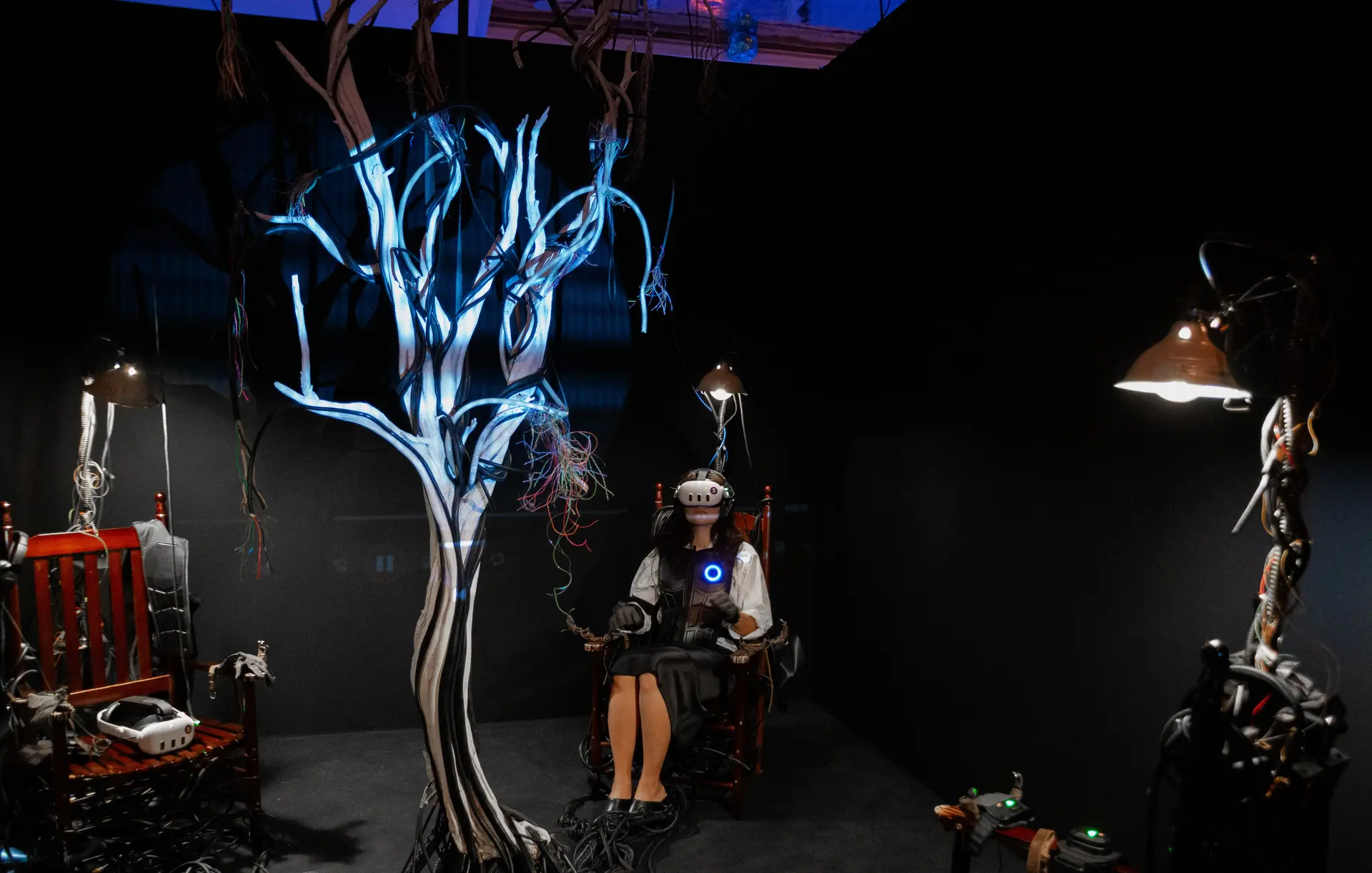
❋
4. Conclusions
Diversion. Cannes 2025.
In this study, we mapped the IX industry and looked at how distribution is currently approached. A number of best practices were then described, not only within IX, but also within other cultural sub-sectors in the Netherlands and beyond.
From the interviews conducted, it emerged that a more integrated approach - in which distribution is part of the development process from the beginning - can help solve many current bottlenecks. Distribution should be a full and strategic phase within the life cycle of immersive experiences.
Thinking early on about the intended audience, the venues where screenings can take place, and what forms or versions the work could take, will ensure more sustainable impact. For example, it is clear that documentation is crucial in project development, allowing the work not only to be better disseminated, but ultimately preserved and archived, thus ensuring a longer life.
Here are the key findings of the study:
A more holistic and long-term view of the life cycle of an immersive production can benefit the distribution and viability of an IX work. Such an approach transcends traditional project phasing and encourages creators to think about audiences, distribution, and the future value of their work from the very beginning.
Within sustainable lifecycle thinking, version control is crucial. This includes not only continuous prototyping to reinforce quality and relevance during the production process, but also developing a versioning strategy. In practice, however, there often appears to be insufficient financial room for further development.
Continued strong segmentation within the distribution field - with both small-scale modes of presentation for home use and large-scale installations on location that are only profitable in metropolitan contexts - makes it complicated to develop a sustainable and scalable revenue model.
That creators are always focused on making new work is fuelled in part by the lack of opportunities with funding bodies to apply for the further development of existing work. This shortens the life cycle of projects considerably.
The Dutch immersive sector would benefit from a place, or organisation, that offers structural support to creators and producers. Similar to the role Dutch Game Garden has played within the game industry, a central hub for immersive experiences would promote knowledge sharing, provide access to technical facilities and create space for showing prototypes to partners and the public.
This report has explored distribution opportunities for immersive experiences in both the home and online context, as well as in physical locations. For XR, while location-based experiences continue to play an important role in audience experience, online platforms also offer serious opportunities for distribution.
There is a clear need for individuals and companies that specialise in the distribution of immersive experiences. They would handle the entire strategy of distribution, and be involved early in the development. Pooling and collaborating is crucial for structural improvement in distribution.
The immersive sector could benefit significantly from incentives similar to those in film, such as incentives for distributors who commit to culturally diverse or artistically innovative works.
Using existing distribution models from different sectors (film, performing arts, digital and media arts, games, music), it appears that a strategy that integrates multiple distribution models can ensure longer visibility and more sustainable exploitation. The more diverse the forms of distribution deployed, the more likely a work is to reach multiple audiences and remain economically viable.
❋
5. Recommendations
Buycloud. Noa Jansma. Photo: Joke Schut
"What makes distribution so interesting is that you can present a work even years later, over a longer period of time, and not just right after it's made." Gaby Wijers
"IX is many things at once, and that's exactly the challenge we face. We are dealing with an emerging platform that is still developing and growing. It's actually a synthesis of all the other art forms." Sara Tirelli
"Distribution is crucial. Until we get the distribution side right, you can make a masterpiece, but it won't reach many people. And that's so important." Tupac Martir
This report shows that the future of distribution in the immersive arts requires a fundamental revision of existing practices and the simultaneous construction of new, sustainable structures. Central to this is the need to see distribution no longer as the final piece, but as an integral part of the life cycle of projects.
Ongoing research as a prerequisite
Our research has shown the need for continuous reflection and knowledge sharing, in part because of rapid technological and institutional developments. In addition to the current study, a long-term project by MIT in collaboration with IDFA is currently underway, aimed at developing play pipelines and distribution strategies. The insights from these and other pathways will be essential in the years ahead to make distribution not only better, but also more collectible, future-proof and equitable.
Strategic Recommendations for the Sector
1. Implementation of lifecycle thinking
Development of an integrated project approach
Creators and producers should include distribution in their project development from the concept phase. This requires creating distribution roadmaps that detail different phases - from prototype to archiving. Funding bodies should encourage this by requiring distribution plans to include roadmaps in grant applications and by having separate budget items for distribution activities.
Versioning as standard practice
The industry should work to develop different versions of the same work (small, medium, large) to enable flexible presentation. This includes both prototyping during the development phase and strategically creating multiple final versions for different contexts and audiences.
2. Infrastructure development
Establishment of a national knowledge centre
The Netherlands needs a central hub for immersive experiences, similar to the role Dutch Game Garden played in the game industry. This organisation would facilitate knowledge sharing, provide access to technical facilities, create space for prototype testing and act as a national point of contact for the industry. A national infrastructure should also be explored, accessed through the national knowledge centre, for smaller parties and offering digital community assets.
Development of distribution expertise
There is an urgent need for specialised distributors and marketing professionals focused entirely on immersive content. These intermediaries must be involved early in projects and master the entire distribution chain - from strategy to execution.
3. Strengthening presentation capabilities
Expanding physical distribution
The industry must actively work to develop touring kits and installation specifications that are scalable and replicable. Combining multiple titles into group exhibitions greatly increases opportunities for Location-Based Entertainment (LBE). In addition, partnerships should be developed with existing cultural institutions to better utilise their infrastructure.
Exploration of online distribution models
Strategic research should be conducted into online distribution platforms outside the well-known game stores. Inspiration can be drawn from revenue models of Netflix, Spotify, iTunes, Kindle, YouTube and media platforms such as Nowness. Experimentation with blockchain-based distribution, copyleft licensing and community-driven platforms deserves attention.
4. Knowledge and legal frameworks
Development of documentation standards
Universal roadmaps and documentation templates should be developed by experts such as LI-MA and Nxt Museum in collaboration with creators. These formats should become part of creative education programmes and be widely available to the industry.
Standardisation of licensing and contract models
The industry urgently needs standardised contracts and licensing models for intellectual property. There must be clear guidelines on exactly what is licensed - specific versions of works or adaptation rights - and transparent agreements on ownership relationships between creators, producers and distributors.
Preservation and heritage management
The sector should seek structural affiliation with heritage networks such as NADD and NDE. Establishing national awards that encourage conservation can help canonisation and long-term accessibility of important works. LI-MA and other heritage experts can play an important and active role in deeper heritage research and conducting case studies if funded.
Knowledge sharing
Ways of setting up a central knowledge-sharing desk should be explored. Part of this could be an open database for sharing certain data, such as all suitable screening locations and training in the field of IX.
5. Financial instruments and policies
Expanding funding opportunities
Funding bodies should provide more room for further development of existing works and distribution activities. It is recommended to introduce similar incentives as in the film sector, such as incentives per visitor or screening for culturally diverse works.
Following the example of the immersive network in Great Britain, funded by the British Council, funding bodies in the Netherlands should also offer more scope for supporting collaborations, networks and infrastructure, not just individual creators or productions.
Evaluate and improve existing schemes
The current distribution scheme for immersive works should be thoroughly evaluated for effectiveness. In addition, we need to investigate whether presentations of IX can fall under existing presentation schemes of Performing Arts Fund NL.
6. Marketing and visibility
National marketing strategy
A central marketing office should be set up to promote the (inter)national visibility of Dutch immersive productions. This can be carried out by existing organisations such as Moonshot or See NL, or through a new specialised structure.
Audience development
The sector should work systematically on audience approach and making immersive works accessible. Developing a Dutch variant of 'The Festival Collection' can increase visibility and unburden presentation venues.
Follow-up Actions and Implementation
Short term (1-2 years)
• Creation of documentation standards and roadmaps
• Development of standard contracts and licensing models for intellectual property
• Evaluation of existing distribution scheme
• Exploration of partnerships with heritage institutions
• Development of initial touring kits and versioning strategies
Medium term (2-5 years)
• Establishment of national knowledge centre
• Implementation of new financing instruments
• Development of specialised distribution expertise
• Rollout of national marketing strategy
Long term (5+ years)
• Mature distribution ecosystem with professional intermediaries
• Stable online and offline presentation networks
• International positioning of Dutch IX sector
• Sustainable preservation and archiving structures
Role of different stakeholders
• Creators and producers should adopt lifecycle thinking and develop distribution strategies from the start of projects.
• Funds should structurally enable financing of distribution and further development.
• Cultural institutions can open their infrastructure more broadly and form partnerships.
• Governments can create policy frameworks that encourage innovation and collaboration.
• Industry associations play a crucial role in developing standard contracts and licensing models (in collaboration with legal experts) that help professionalise the sector.
The challenge lies in coordinating these various parties into a coherent ecosystem in which immersive works are not only created, but can also sustainably circulate and reach their audiences. Only through joint effort can the Dutch immersive sector fully realise its potential and take a leading position internationally.
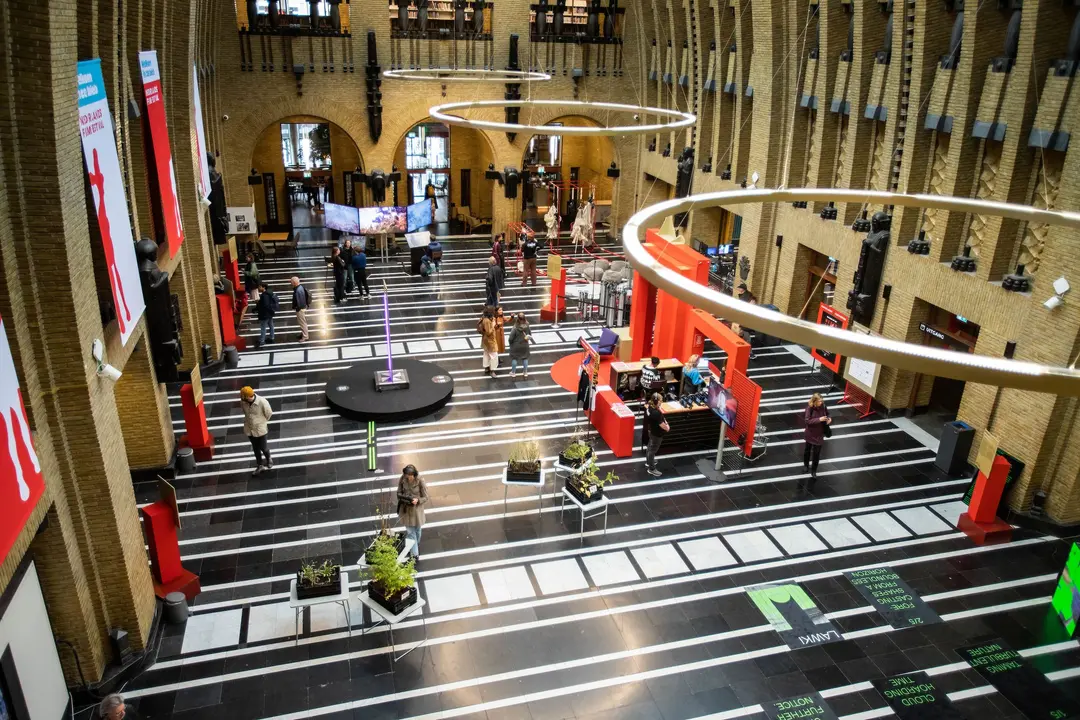
❋
Appendices
NFF Storyspace
Appendix 1 – List of Interviewees
Boris Acket – Maker
Yannis Bolman – CEO Little Chicken Game Company
Paul Bouchard – Head Acquisition and Development Diversion cinema
Bogomir Doringer – Curator Nxt Museum
Merel van Helsdingen – Director Nxt Museum
Marijke Hessels – Tech dramaturg
Nienke Huitenga – Maker
Camille Lopato – Founder Diversion cinema
Tupac Martir – Maker, founder Satore Studio
Corine Meijers – Producer Studio Biarritz
Marieke Nooren – Specialist distribution and partnerships
Abner Preis – Maker
Amy Rose – Head Immersive, Watershed
Caspar Sonnen – Head, IDFA DocLab
Sara Tirelli – Maker, co-founder CSC Immersive Arts
Gabey Tjon-A-Tham – Artist
Vevi van der Vliet – Business director Li-Ma
Gaby Wijers – Director-bestuurder Li-Ma
Babette Wijntjes – Founder Cassette and founder Nu:Reality
With thanks to the participants in the Moonshot Expert meeting
(19 September 2024):
Avinash Changa – Director WeMakeVR
Boris Debackere – Head Production V2_Lab
Julius Horsthuis – Maker
Niki Smit – Artistic Director Monobanda
Caspar Sonnen – Head IDFA DocLab
Zalán Szakács – Maker
Ruth Timmermans – (former) Distributor Li-Ma
Jenni Tuovinen – Head New Media Operations IDFA DocLab
Appendix 2 – Desk Research
A new era for distribution of media art – eds. Rachel Somers Miles & Gaby Wijers (Li-Ma, 2023)
The creative immersive content lifecycle: from distribution to restoration (Digital Catapult, 2021)
Survey of the distribution of immersive media in The Netherlands (Cassette, 2022)
Baseline Rapport: Het Nederlandse XR Ecosysteem (ROM Utrecht Region, Dutch XR, OASIS, Media Innovation Hub, 2024)
Think Tank – Immediate Options to Address the Pressing Needs of Immersive Distribution – Michel Reilhac, Liz Rosenthal and Doede Holtkamp (Venice Immersive, 2023)
XR and its potential for Europe (Ecorys Brussels, 2021)
How does Belgium begin its shift towards immersive creation? – Adrien Cornelissen
Understanding of the market and needs of XR companies in France (CNXR, 2023)
Full report of the IDFA DocLab R&D Summit 2024 (IDFA, 2025)
The LBE Market: Immediate Options to Address the Pressing Needs of Immersive Distribution and Exhibition in Venues – Michel Reilhac, Liz Rosenthal and Doede Holtkamp (Venice Immersive, 2024)
Market analysis of the cultural and creative sectors in Europe. A sector to invest in (European Investment Fund, 2021)
Cultuurmonitor: Games (Boekmanstichting, 2025)
Common ground. A UK touring report – Darren Emerson, Dan Tucker and Anthony Comber Badu (British Film Institute, 2020)
The Immersive Audience Journey (Digital Catapult, 2020)
Innovation in Future Convergent Media and Virtual Production Technologies (XR Network+, 2023/2024)
Immersive Audiences Report 2024 (Immersive Experience Network, 2024)
Digitale Cultuur: Een uitgestrekt terrein zonder strikte grenzen (PACCT, 2024)
The Business of Digital Art: Economic Models and Insights into the Future (Digital Inter/Section, 2024)
A Handbook for Immersive Producers. How to successfully finance, produce and distribute immersive content (French Immersion, 2021)
Future Art Ecosystems. Vol 2. Art x Metaverse (Serpentine R&D, 2021)
Case studies
Touring VR: In Pursuit Of Repetitive Beats – Darren Emerson (Immersive Experience Network, 2024)
Onassis ONX
New Business Models for Digital Art & Culture Organisations (Digital Inter/Section, 2024)
A Practical Research into Preservation Strategies for VR artworks on the basis of Justin Zijlstra's 100 Jaar Vrouwenkiesrecht (NDE, Atria, Li-Ma, 2021)
Distribution model film
On & For Production and Distribution. Distribution Models. A Motley Landscape. How Films Travel – Nina de Vroome, 2019
Distribution model media art, digital art
A Fly on the Distributor's Wall. What Do Distributors Do? – Helen Westerik, 2017
Artwork Documentation Tool – Li-Ma
Future Art Ecosystems. Issue 1. Art x Advanced Technologies (Serpentine R&D, 2020)
Preserving and Exhibiting Media Art. Challenges and Perspectives – eds. Julia Noordegraaf, Vinzenz Hediger, Cosetta Saba, Barbara Le Maitre (Amsterdam University Press, 2012)
Distribution model performing arts
Het economisch drama van de podiumkunsten – Cees Langeveld (Erasmus Universiteit, 2009)
Uit! Naar gesubsidieerde podiumkunsten met een nieuw élan (Fonds voor Amateurkunst en Podiumkunsten, 2006)
Kunst & klant in de Nederlandse podiumkunsten – K.S. Joostens (Rijksuniversiteit Groningen, 2012)
Gijzeling van de toeschouwer – Marijn van den Bogaard (Amsterdamse Hogeschool voor de Kunsten, 2021-2022)
Er midden in: Theater en kritiek in een belevingscultuur – Mineur, F.J.W. (Maastricht University, 2022)
Distribution model games
The developments of business models in video games due to changes in distribution channel – Andre Evic (Wageningen University and Research, 2020)
Monetization Models in The Gaming Industry: A Comparative Analysis of In-Game Purchases, Subscriptions, And Free-To-Play Strategies – Kumar Divya (International Journal for Multidisciplinary Research, Volume 6, Issue 1, January-February 2024)
Analyzing Digital Game Distribution in Gaming Industry: A Case Study – Dr. Eric Blancaflor and Jan Martin Gomez San Miguel (IEOM Society International, 2022)
Events and entertainment in the metaverse (Internetmatters.org)
How Fortnite and Roblox are becoming marketing tools for the music industry (Digiday, 2024)

Appendix 3 – Technical Conservation Documentation
A starting point for a documentation template, derived from software engineering documentation
1. General Project Information
• Project title:
• Creator(s) / Studio:
• Year of production:
• Description: (brief content + form, e.g., VR installation, AR app)
2. Game Engine Used
• Engine: Unity / Unreal Engine
• Version:
• Build type: (Standalone, WebXR, Mobile, etc.)
3. Software Runtime Environment
• Target platform(s): (e.g., Oculus Quest 2, HTC Vive, browser)
• Operating system: (e.g., Windows 10, Android 11)
• Hardware requirements: CPU, GPU, RAM, HMD type
• Input methods: Controllers, hands, tracking, etc.
4. Engine configuration
• Render pipeline (Unity): Built-in / URP / HDRP
• Graphics settings: resolution, anti-aliasing, shadows, shaders
• Physics engine: standard / custom
• Audio engine: standard / third-party plug-in
• Network config (if applicable): multiplayer framework or protocols
5. External Software Libraries / Plug-ins
A list of all external packages added to the project. For example:
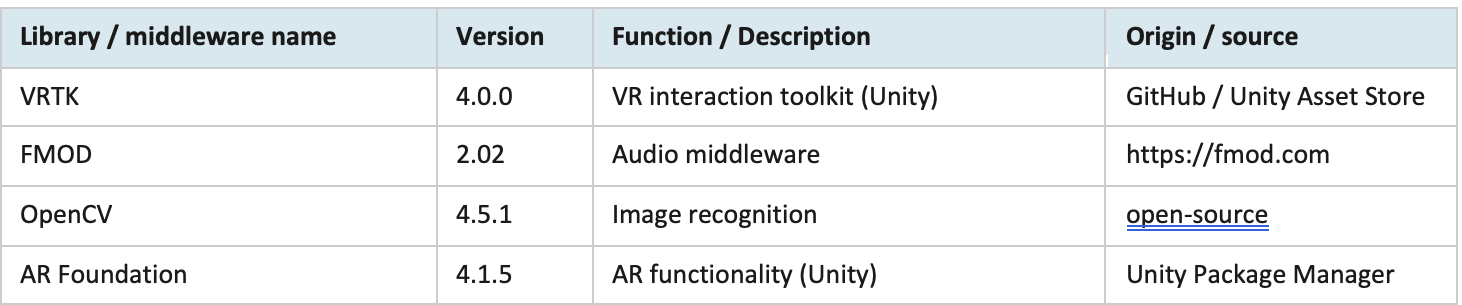
6. Build information
• Build tool: Unity Build-in / Unreal Build / CI pipeline
• Last working build: version number + date
• Build output: APK, EXE, WebGL, etc.
• Build settings export file: [attached .json / .xml / .ini]
7. Version control & source documentation
• Version control system: Git / SVN / other
• Repository URL or backup location:
• Rebuild instructions: step-by-step plan (optional in README.md)
• Licence information (software and assets)
8. Hardware and Physical Components
Equipment:
List of required hardware (computers, VR/AR headsets, screens, projectors, speakers, sensors, microphones, haptic vests, etc.) Specifications: brand, model, OS, firmware versions, connections
Props & Decorative elements:
Objects such as furniture, (fake) equipment, clothing, decorative pieces Dimensions, materials, assembly and storage instructions
Technical installations:
Lighting or sound equipment, smoke machines, wind machines, moving parts (e.g. servos or motors) Diagrams of connections and maintenance requirements
Installation guidelines:
• Spatial requirements (square metres per person, ceiling height)
• Set-up time and required technical crew
• Training of hosts or technicians
9. Artistic Specifications
• Artistic intention (brief): (e.g. what are crucial elements that must not be lost?)
• Installation models to be approved: (e.g. settings for exhibitions or events)
10. Known Issues & Notes
• Known bugs, limitations
• Technical dependencies (e.g. specific software versions, incompatibility)
• Explanation of choices (e.g. why a particular middleware was used)
11. Appendices
• Screenshots of interface & installation
• Diagrams of software architecture or runtime environment
• Licence files, binaries, installation folders, README.md
Optional: video recordings or walkthrough of installation
Appendix 4 – Formation Roadmap
Below is an outline of possible steps to take in order to build up documentation.
Preparation and basic documentation
• Record the original technical setup (including floor plans, equipment, software versions) (see Appendix 3 for a starting point).
• Collect creative starting points: concept description, creator's intentions, intended audience experience.
Create a first version of the tech rider and concept bible
• Set up the "live document".
• Set up a central and accessible documentation system (e.g. shared folder or project wiki).
• Establish that this is a "living document": it grows with the project and also contains informal, ad hoc decisions.
• Determine who is responsible for keeping track of updates.
• Collect and retain all original video materials, walkthroughs, photographs and a technical paper.
Analyse the work for dependencies on OS, software and hardware
• This will enable you to retain the necessary resources (hardware, peripherals, source code, executables and media assets (e.g. video, audio).
• Also pay attention to retaining used drivers and dependencies on SDKs, such as Android and iOS tools for AR development.
Copy the data to a suitable archive location
• It is mandatory to store multiple copies in at least two different locations.
• Optional: migrate to new hardware or a software emulation solution. This will change the work, is that acceptable?
Document during setup and/or production
• Record technical adjustments and improvised solutions (e.g. bugs, cable routing, software or hardware adjustments).
• Take photographs, videos and/or 3D scans of the setup.
• Note which equipment and configurations were ultimately used (including version numbers and settings).
• Record any deviations from the original plan.
Recording audience interaction and experience
• Describe the sequence of actions and experiences for visitors (e.g. reception, waiting time, steps in the experience).
• Note the necessary staff roles (such as host, technician, guide).
• Collect feedback on how the audience experiences the experience (if possible).
• Make audience experience recordings: sensor and screen recordings.
• Also consider how this content can be played back.
Drawing up a service design blueprint (a handover for future partners)
• Create a service blueprint in which you visualise: Front stage (visitor actions and experience) and Back stage (processes and people behind the scenes who make this possible).
• Record the relationship between spatial layout, technology and audience interaction.
• Add a "franchise" instruction document for external contractors or partners.
Archiving physical elements and location information
• Store or document important physical props or installation parts.
• Record characteristics of the original (ideal) location: dimensions, acoustics, light incidence, infrastructure.
Evaluation and updating
• Have the technicians, designers and creators involved check the document for completeness.
• Update the document after each reinstallation or performance.
• Schedule regular reviews to keep the document up to date.
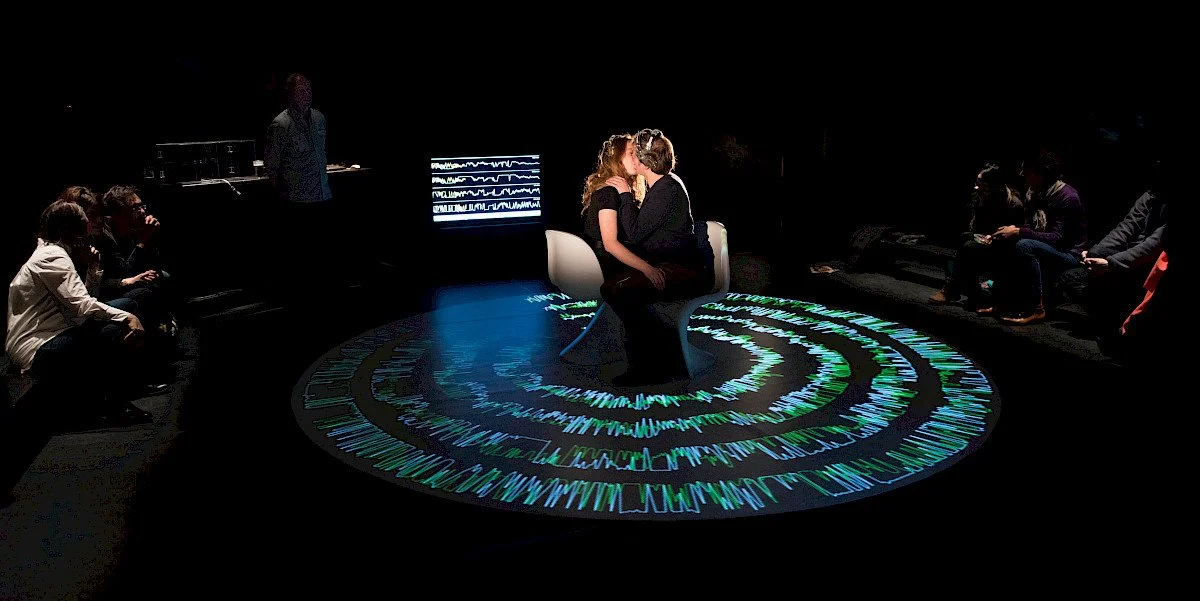
❋
Also check the study of Nieuwe Instituut did in collaboration with Moonshot Digital Culture, evaluating the results of the Cultural Immersive Productions Pilot voucher scheme, which was implemented by the Creative Industries Fund at the end of 2023.
Lancel Maat EEG Kiss